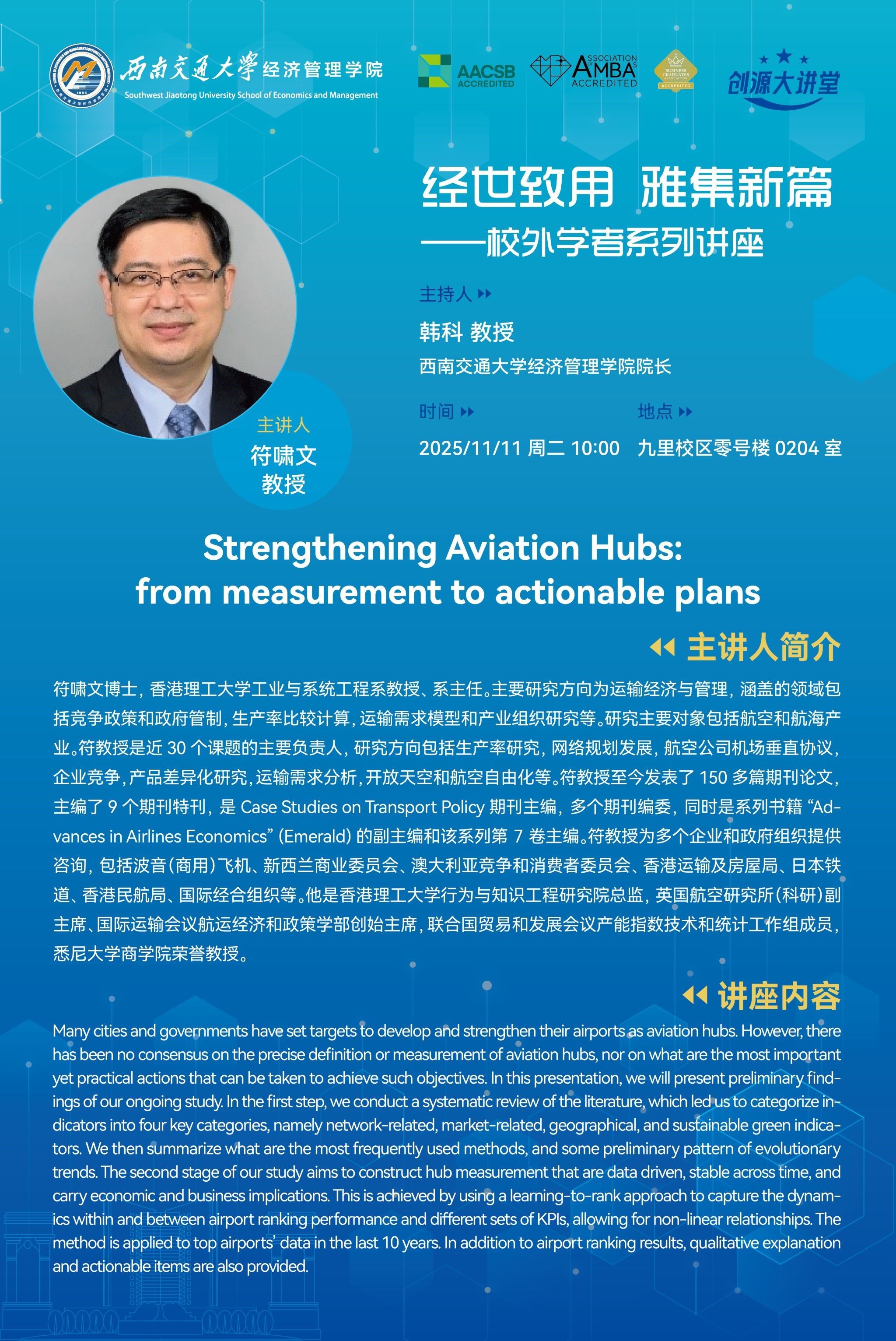
Speaker Profile
Dr. FU Xiaowen is a Professor and the Head of the Department of Industrial and Systems Engineering at The Hong Kong Polytechnic University. His research focuses on transportation economics and management, with expertise in competition policy, government regulation, productivity analysis, and industrial organization, primarily within the aviation and ground transport sectors. As a Principal Investigator on nearly 30 projects, he has extensively studied topics ranging from airline codeshare agreements to the impacts of aviation liberalization.
An accomplished author, Professor Fu has published over 150 journal articles. He serves as the Editor-in-Chief of Case Studies on Transport Policy and is a Series Co-Editor for Advances in Airline Economics (Emerald). He has provided expert consultation to major organizations such as Boeing, the ACCC, and various transport authorities. His leadership roles include serving as Director of the Research Institute for Business at PolyU, Vice President (Research) of the Air Transport Research Society (ATRS), and an Honorary Professor at the University of Sydney Business School.
Abstract
Many cities and governments have set targets to develop and strengthen their airports as aviation hubs. However, there has been no consensus on the precise definition or measurement of aviation hubs, nor on what are the most important yet practical actions that can be taken to achieve such objectives. In this presentation, we will present preliminary findings of our ongoing study. In the first step, we conduct a systematic review of the literature, which helps us to categorize indicators into four key categories, namely network-related, market-related, geographical, and sustainable green indicators. We then summarize what are the most frequently used measures, and some preliminary pattern of evolutionary trends. The second stage of our study aims to construct a hub measurement that is data-driven, stable across time, and carry economic and business implications. This is achieved by using sets of KPIs, allowing us to capture the dynamic ics within and between airport ranking performance and different learning-to-rank approach for non-linear relationships. The method is applied to top airports' data in the last 10 years. In addition to airport ranking results, qualitative explanation and actionable items are also provided.
Date/Time: November 11, 10:00 a.m.
Venue: Room 0204, Teaching Building 0, Jiuliu Campus